
Why Do Parts Lose Ground in a Powder Coating Plant?
Parts lose ground because cured powder has covered the hook contact point, or because the ground path through the conveyor has broken down. Powder is an insulator. Once it coats the contact area, the part stops conducting, the charge cannot escape, and powder stops sticking. Most operators blame the gun first. In a powder coating plant, the gun is usually the last thing to blame.
What Losing Ground Looks Like in a Powder Coating Plant?
Grounding faults seldom hit the whole line at once. They show up in four ways, and every one of them is local:
– Bare metal at the contact point, and around it
– Powder falling off parts before they reach the oven
– The side facing away from the hook taking less powder
– Different film thickness on two parts hung from the same hanger
Read those four together and you see a broken circuit. You do not see a bad setting.
Why Does a Coated Hook Stop Conducting?
Cured coating is a polymer, and polymers do not conduct. A hook that has run a few hundred passes carries a layer of it at the contact tip. That layer adds resistance to the ground path. A small contact area makes the effect worse.
Two habits kill the circuit before the part enters the booth. Operators re-hang parts on hooks nobody stripped. Or they hang parts so the contact sits on an oiled, oxidized, or already-coated surface.
Hook geometry decides how fast the contact dies. A flat hook resting on a wide painted face loses its path after a few passes. A hook with a small, sharp tip holds a path open far longer, because the coating cracks away at the point.
Where Does the Ground Path Break Down?
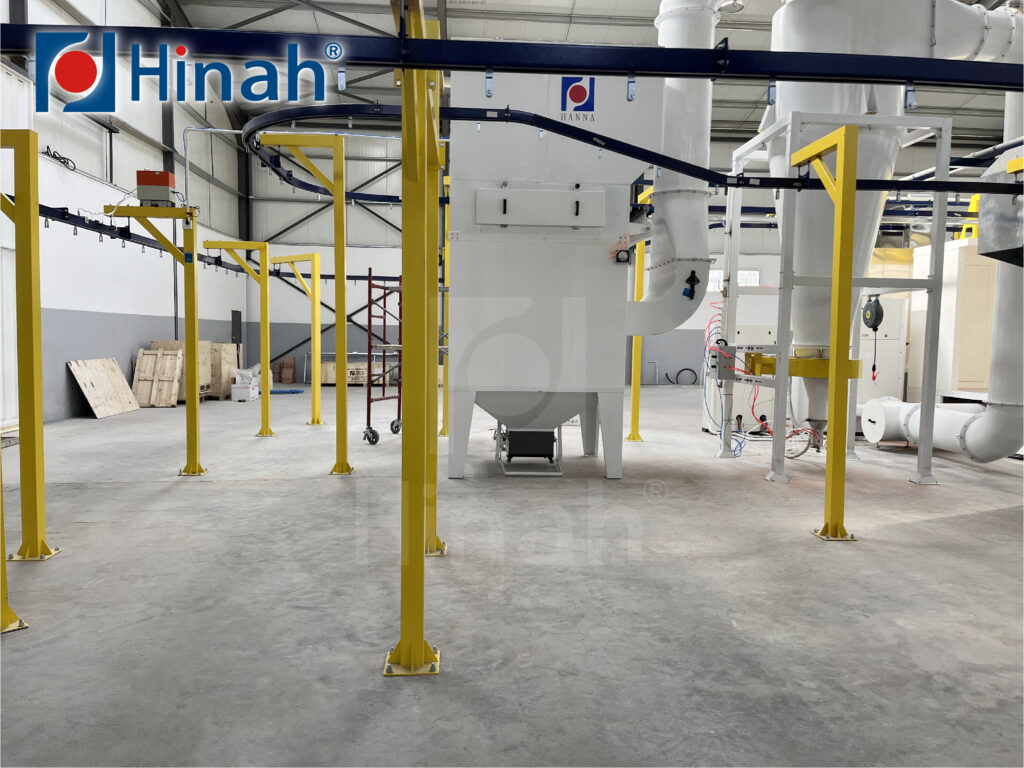
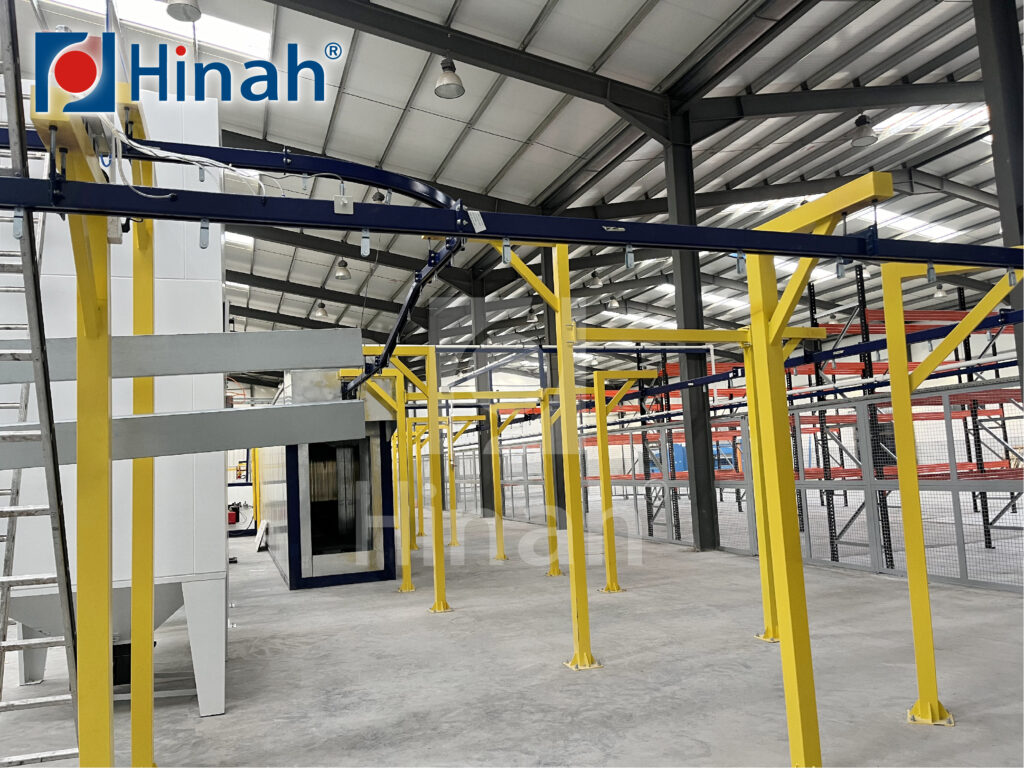
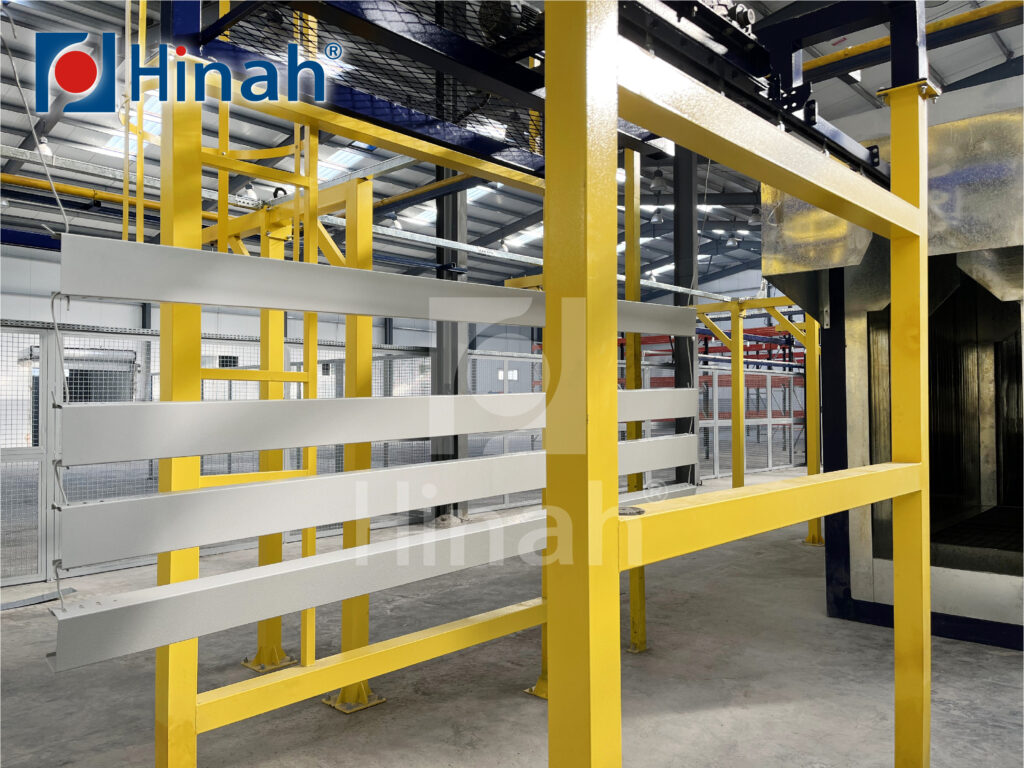
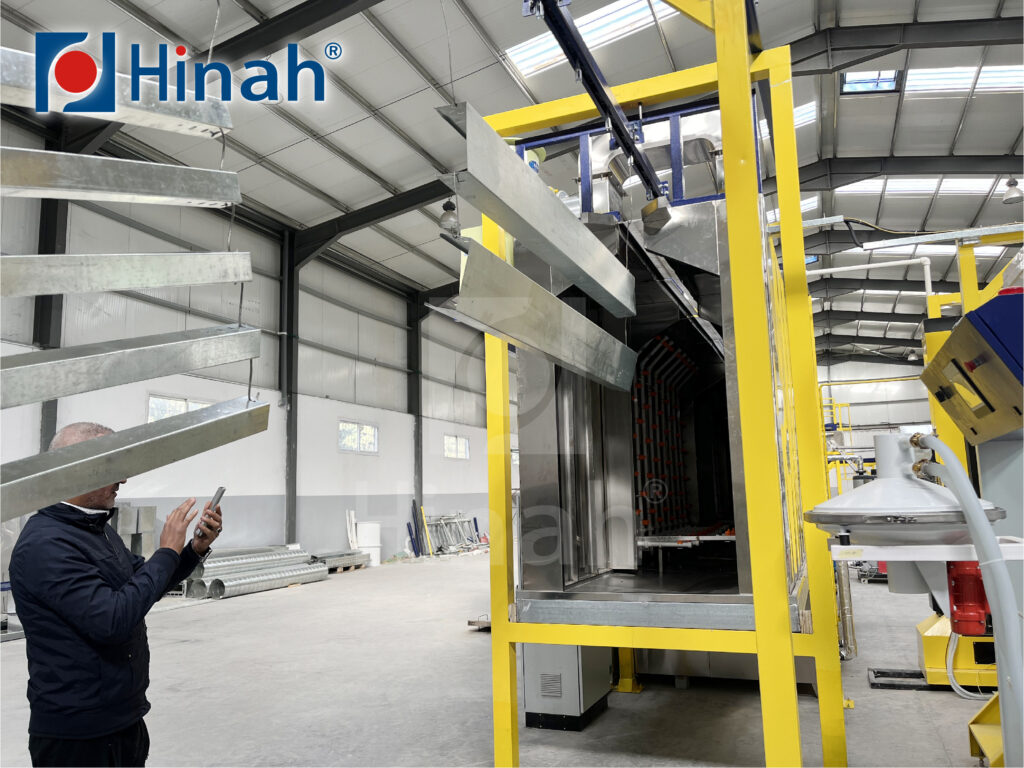
The path runs through several joints, and every joint can add resistance. Follow it in order. Start at the hook. Move to the hanger or trolley. Then the wheel and bearing, the rail, the collector or grounding brush, and finally the earth network that serves the whole powder coating plant.
The joints people skip are the same ones every time. Powder builds up inside the rail. Chain lubrication dries out. The collector brush wears and lifts off. Paint or cured powder covers the sliding contact inside the booth. Any one of them breaks the path.
How Do You Tell Grounding Apart From a Gun Problem?
Run three checks before you touch a gun setting.
Hang one clean, freshly stripped hook beside the suspect hook, and coat both. If the stripped hook coats well, the fault is the hook. Then compare parts hung at different points in the same booth. If only one point fails, the fault sits in the support, not in the gun. Finally, stop the line and measure from the part to plant earth. A reading that jumps around means the contact is intermittent.
Do not raise the voltage to chase bare spots. Over-charging pushes powder away from the part, and back-ionization follows.
What Do the Standards Actually Require?
US rules already cover this problem. OSHA 29 CFR 1910.107(i)(7) requires that coated objects stay in metallic contact with the conveyor or another grounded support. It requires regular hook cleaning to keep that contact, and it calls for contact areas shaped as sharp points or knife edges where possible. Section 1910.107(l)(6) applies the same paragraph to powder coating handguns, and 1910.107(l)(7)(iv) repeats the hook rule for electrostatic fluidized beds. Section 1910.107(c)(9)(i) adds that metal parts of spray booths, exhaust ducts, and piping systems carrying aerated solids must stay grounded in an effective and permanent way.
Sharp points earn their place because the electric field concentrates there. Regular hook cleaning earns its place because the rule assumes hooks will foul. Every clause above points at the same component, and in a powder coating plant that component is the hook.
What Should You Check Every Shift in a Powder Coating Plant?
Stripping keeps the loop closed. Most plants pick one method and stay with it, either a burn-off oven, a chemical strip tank, or mechanical cleaning. Whichever you choose, rotate hook stock so no hook stays in service until it fails.
– Strip and rotate hooks on a set cycle
– Check the collector brush, and clean powder out of the rail
– Keep the chain lubricated
– Confirm every hanging point touches bare metal
– Record the hook number whenever bare spots appear
Do these five things, and a random defect turns into a traceable hook-life problem.
In short: grounding is a chain, and a powder coating plant only needs one weak link to lose it. Check the hooks and the ground path before you change a single gun setting.